Network Deception and AMTD: attackers can’t hit what keeps moving.
PacketViper combines network deception with Automated Moving Target Defense. This deception technology and AMTD continuously morph your attack surface – hundreds of sensors, always rotating – so every scan costs the attacker and every probe generates signal for you.
Static defenses are known quantities. Dynamic ones are minefields.
What is network deception?
Network deception places realistic decoys on your network – fake SSH, RDP, SCADA, PLC, and Active Directory services that no legitimate user or system has a reason to touch. Because nothing real depends on them, any connection to a decoy is a high-confidence sign of scanning or attack. PacketViper builds deception into the same inline appliance that enforces your traffic, so the moment someone touches a decoy the source is blocked and the block is shared across every unit in your enterprise. Paired with Automated Moving Target Defense, which keeps the real surface changing, attackers cannot build a reliable map to attack.
PacketViper’s core preemptive defense capability.
It removes the reconnaissance advantage attackers have relied on for decades.
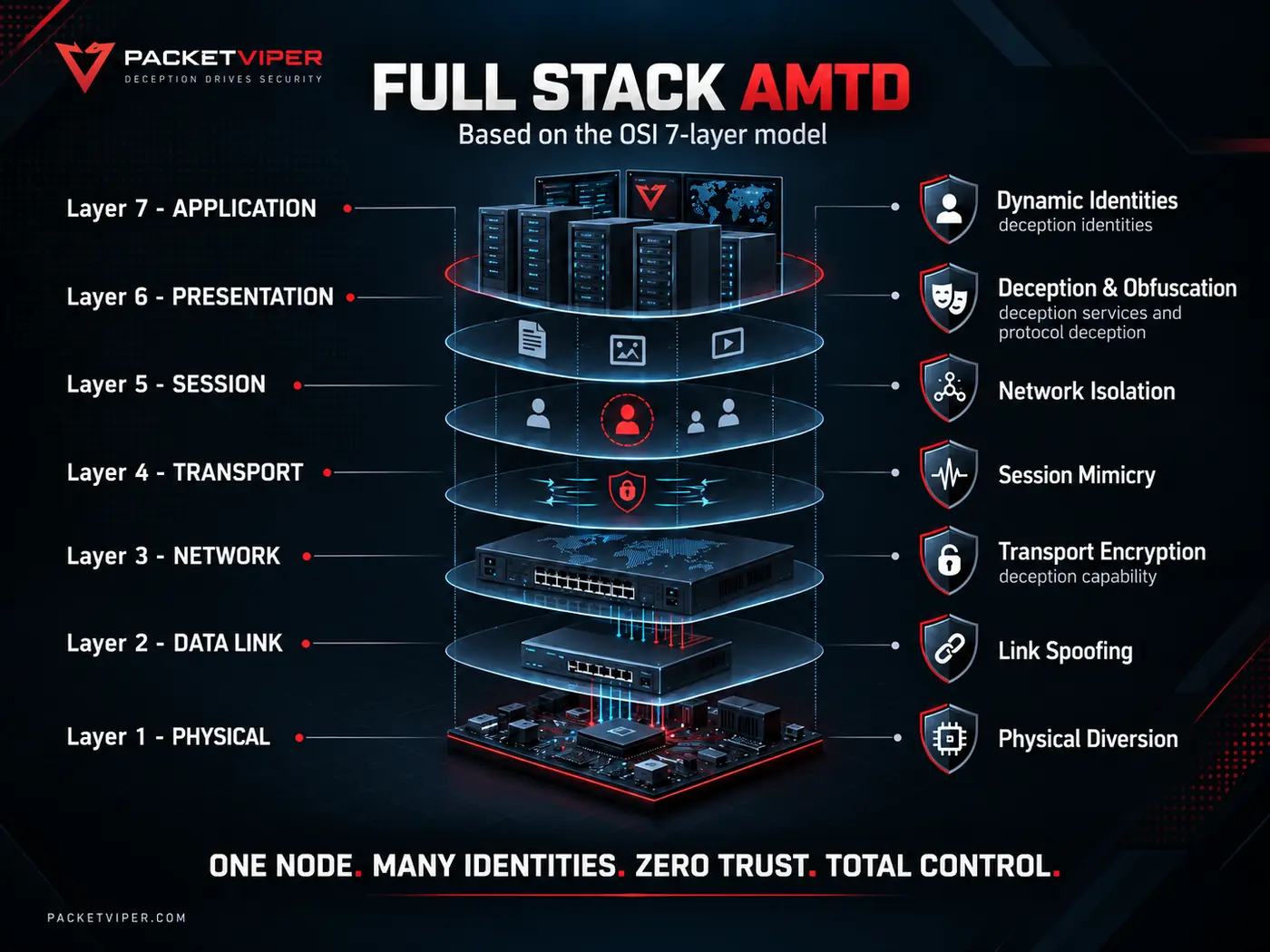
AMTD vendors take different approaches: some work on the endpoint (Morphisec, for example, randomizes process memory and runtime on the host), others at the network layer. PacketViper is network-layer, inline and agentless, with an optional endpoint agent. Full-Stack AMTD goes further by making the attacker’s tools themselves unreliable. When an adversary uses Nmap, Nessus, Shodan, BloodHound, or similar tools against a PacketViper-protected environment, the information they receive is no longer trustworthy.
This is not detection after the fact. It is prevention at the reconnaissance layer. Full-Stack AMTD works together with PacketViper’s endpoint AMTD agents, OT security integrations, and full contextual awareness to deliver prevention, detection, and notification in one platform.
Your network is a map.
Attackers have a copy.
Traditional security assumes a static environment – defined IPs, fixed services, predictable behavior. Attackers exploit exactly that predictability. Before they strike, they spend hours – sometimes days – mapping your infrastructure, cataloging every service, fingerprinting every device.
By the time a threat appears in your SIEM, the reconnaissance is complete. The attacker already knows more about your network than most of your own team does. Every perimeter rule, every ACL, every asset – cataloged, weaponized, waiting.
“A security tool that can be mapped is a tool that can be beaten.”
Deception-based defenses flip this model. Instead of hardening a static surface, PacketViper makes your surface a moving target – so every scan gets different results, every probe hits a sensor, and every fingerprint goes stale.
The five-step loop that never stops.
AMTD isn’t a one-time configuration – it’s a continuous loop that runs autonomously. The surface rotates, the decoys respond, and every attacker interaction becomes intelligence. Here’s what happens from first probe to fingerprint.
No manual tuning. No alert fatigue. No human-in-the-loop required for enforcement – only for the insights that matter.
Attacker begins reconnaissance
Port scans, banner grabs, SNMP walks – the attacker starts mapping. On a conventional network, this works exactly as expected.
Sensors detect the probe
PacketViper’s distributed sensors – deployed across every segment – detect the probe instantly. Attribution begins: source, timing, method, intent pattern.
AMTD rotates the surface
The visible network surface shifts – IPs, ports, banners, service signatures. What the attacker just mapped is already wrong. The next scan will return different results.
Probe hits decoy – inline enforcement fires
The attacker follows their map to what looks like a real asset. It’s a decoy. The moment they interact, inline enforcement engages – block, throttle, redirect, or capture, depending on your policy.
Mapping failed and they’ve been fingerprinted.
Every probe, connection attempt, and decoy interaction builds a persistent attacker profile. The attacker wasted hours. You have a complete behavioral fingerprint, enriched with context, ready for your SOC.
Every layer of your defense, reinvented.
AMTD isn’t a single technique – it’s a platform capability that touches every part of your network posture.
The industry has largely reduced moving target defense to rotating placement alone – where a target sits. That is one axis. PacketViper rotates three, in the same action, every time:
Where targets are presented
Placement rotates continuously across the address and port space.
Where you are watching
Coverage of the unpresented dark space is recomputed on every rotation – never a port actively presenting a target, never a just-vacated port left uncovered.
When enforcement fires
The block threshold re-rolls within a configured band on every rotation, so a measured limit only ever holds for one cycle.
Rotation denies an attacker any lasting memory of us. Watching dark space gives us accumulating memory of them – we remember them; they cannot remember us.
Dynamic Surface Rotation
Continuously randomizes IP addresses, open ports, service banners, and protocol responses – making every network scan a new experience for the attacker. Coverage moves with it: on every rotation PacketViper recomputes which ports are watched as dark space in the same action, so placement and monitoring always change together.
Deception Grid Deployment
Hundreds of convincing decoy assets – fake services, emulated devices, honey credentials – distributed across your real network to attract and trap adversaries.
Attacker Fingerprinting
Every probe contributes to a persistent attacker profile: TTL values, scan patterns, tooling signatures, timing, and behavioral indicators of intent.
Inline Enforcement
Enforcement runs in the packet path – no cloud dependency, no agent, no latency. Block, redirect, throttle, or tarpit attackers in microseconds.
Segmentation Enforcement
AMTD-driven segmentation policies that adapt based on observed behavior – not static rules. Attackers who probe east-west traffic get progressively isolated.
Automated Countermeasures
When an attacker hits a deception trigger, automated infrastructure depletion begins – consuming their time, tools, and resources without human intervention.
Dark Space Monitor
AMTD has always covered more than where targets are placed. Dark space – every port where PacketViper is presenting nothing – is attack surface too, and Dark Space Monitor is how PacketViper delivers coverage of it. Nothing legitimate has any reason to reach into that space, so every hit is a misconfiguration, an undocumented setting, or a threat working the surface it already fingerprinted.
Automated Infrastructure Depletion
When an attacker engages with PacketViper’s deception layer, they don’t just get blocked – they get consumed. Automated Infrastructure Depletion (AID) responds to attacker interaction by feeding plausible-but-false data, stalling connection handshakes, and forcing the attacker to exhaust their tooling against an environment that doesn’t exist.
The result: every minute an attacker spends in your deception grid is a minute they’re not in your real network. And they’re generating signal the entire time. Their tools burn cycles. Their timelines slip. Their operations degrade – automatically, without a single analyst response required.
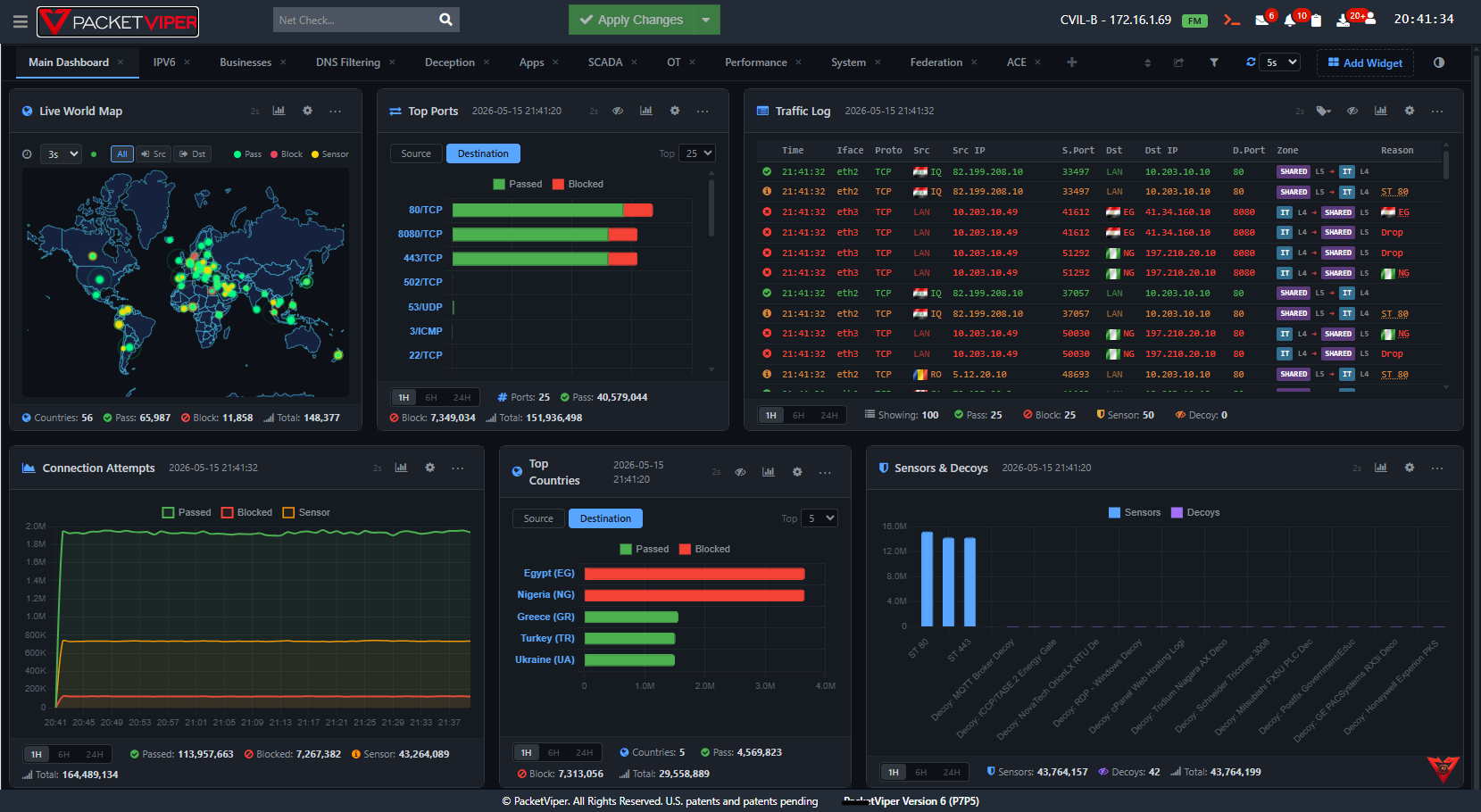
AMTD in production. These are the real numbers.
Production and benchmark figures, each with its test conditions stated.
AMTD now covers the endpoint. Reconnaissance fails on every surface.
The network surface has always been a moving target. Every probe hits a rotating decoy. Every fingerprint goes stale. That is AMTD at the network layer, and it is why PacketViper stopped a rogue AI agent four times in four runs in March 2026.
The endpoint was the remaining gap. A workstation always presented the same ports to the wire. An attacker who landed on a host could survey it freely. Attribution stopped at IP and port, not at process or user.
That gap is closed. Agent-Enhanced AMTD puts the same doctrine inside the host. The port surface rotates minute to minute. Every probe is captured with kernel-level attribution: process, user, executable path. And Hive Auto-Immunity means a compromised host that probes its peers is treated as a confession, not just an alert.
"Before anything gets exploited, something gets mapped. We built PacketViper to make that mapping fail. On the network. On the endpoint. Everywhere reconnaissance has to happen."
Deception is an enforcement trigger, not a honeypot.
A deceptive responder has no legitimate business purpose, so contact with it is a high-confidence signal. PacketViper captures the behavior, evaluates context, and enforces the outcome inline – block, contain, capture the credential, and propagate the decision across the federation. AMTD makes the map unstable; deception makes validating the map dangerous.
The control loop: Observe → Understand → Decide → Enforce → Prove. Detection answers what did we see. Control answers what should be allowed to happen.
Explore the platform
OT / ICS / SCADA Security
Protocol-native protection for operational technology. No agents, no active scanning, fail-safe operation.
Learn moreInvestigation & Threat Intelligence
Every blocked attempt becomes an investigation lead with attribution and context. Misconfiguration, unknown device, or genuine threat.
Learn moreContextual Intelligence
Every connection carries context: identity, geography, protocol, and behavior pattern, applied to every enforcement decision.
Learn moreAsset Management & Discovery
Passive discovery inventories every asset without scanning. 20+ OT protocols recognized, with vendor and model identity for Modbus, Siemens S7, and EtherNet/IP.
Learn moreSee deception in action.
We’ll show you AMTD and deceptive responders running on a live network.
AMTD continuously shifts network characteristics – IP addresses, service configurations, and access points – to deny attackers a stable surface to map and exploit. PacketViper's network-layer AMTD (patent pending), built on its patented multi-context filtering, protects both IT and OT environments without requiring changes to the devices being protected.
Deception technology detects attackers post-ingress – it waits for them inside. AMTD operates pre-ingress: it continuously changes the network parameters attackers need for reconnaissance, making planning efforts futile before they reach a decision point. PacketViper uses both in an integrated architecture.
Deceptive Responders simulate realistic network services – SSH, RDP, SCADA, PLCs, Active Directory portals – embedded directly in the PacketViper appliance. When an attacker engages one, PacketViper immediately blacklists the source and propagates that block enterprise-wide through the CMU. No firewall integration or SOAR required.
Yes. PacketViper's AMTD applies changes at the network enforcement layer, not at the device level. PLCs, RTUs, HMIs, and SCADA systems experience zero configuration changes. Native support for Modbus, DNP3, BACnet, and S7COMM ensures enforcement decisions never block legitimate engineering communications.
At wire speed – the local unit immediately creates a blacklist rule, blocks the source, and notifies the CMU, which propagates the rule to all enterprise units. This happens in milliseconds, without human intervention, without a SOAR playbook, and without external enforcement tools.
Network deception places realistic decoy services on your network – SSH, RDP, SCADA devices, PLCs, Active Directory portals – that no legitimate user or system has a reason to touch. Any connection to a decoy is a high-confidence sign of reconnaissance or attack, and PacketViper acts on it immediately.
A honeypot is a decoy that sits in one place and waits to be found. AMTD continuously changes the network parameters attackers need for reconnaissance – IP addresses, service configurations, and access points – so there is no stable surface to map. PacketViper embeds its deceptive responders directly in the appliance and uses them together with AMTD in one integrated architecture.
No agents are required for network AMTD and deception. PacketViper is an inline, transparent bridge appliance, so no software is installed on the devices it protects – important in OT, where PLCs, RTUs, and HMIs cannot run security software. An optional AMTD Agent is also available if you want rotating deceptive responders on Windows and Linux endpoints themselves.
When an attacker engages a Deceptive Responder, the local PacketViper unit immediately blacklists the source, blocks it, and notifies the Command Management Unit (CMU), which propagates the rule to all enterprise units. This happens in milliseconds, without human intervention, a SOAR playbook, or firewall integration.