One console. Every node. Every site.
PacketViper Federation lets you manage policies, dashboards, updates, and enforcement across every deployment from a single management console. Whether you have 7 nodes or 700.
Scale doesn’t have to mean complexity.
Managing 7 appliances is fine. Managing 70 is a full-time job.
Distributed security deployments create management overhead that scales linearly. Every node needs policy updates, firmware patches, license renewals, and configuration changes. Without centralized management, your security team spends more time maintaining tools than using them.
“Remote OT sites make this worse. You can’t always drive to a pump station or substation to update a device. And you shouldn’t have to.”
Centralized management. Autonomous enforcement.
The Central Management Unit (CMU) provides a single pane of glass for every federated node. Push policies, monitor health, investigate threats, and manage updates across all sites from one interface.
Policy Propagation
Push rules, GNL configurations, and enforcement policies to all nodes simultaneously. One change, every site updated.
Centralized Dashboards
Network health, traffic analytics, and security posture across all nodes in a single view. No jumping between consoles.
Update Manager
Firmware and signature updates deployed to all nodes from the CMU. Schedule updates for maintenance windows.
Traffic Search
Query traffic data across all federated nodes from one interface. Find that IP across every site in seconds.
User Management
Centralized user accounts and permissions. One set of credentials, consistent access control across the enterprise.
License Management
Track and manage licenses for every node in the federation from the CMU. No per-node admin overhead.
One brain. Many hands. One defense.
Centralized command with autonomous, decentralized defense. The Hub coordinates policy and cross-fleet pattern correlation. Every node enforces independently — even if the Hub is offline.
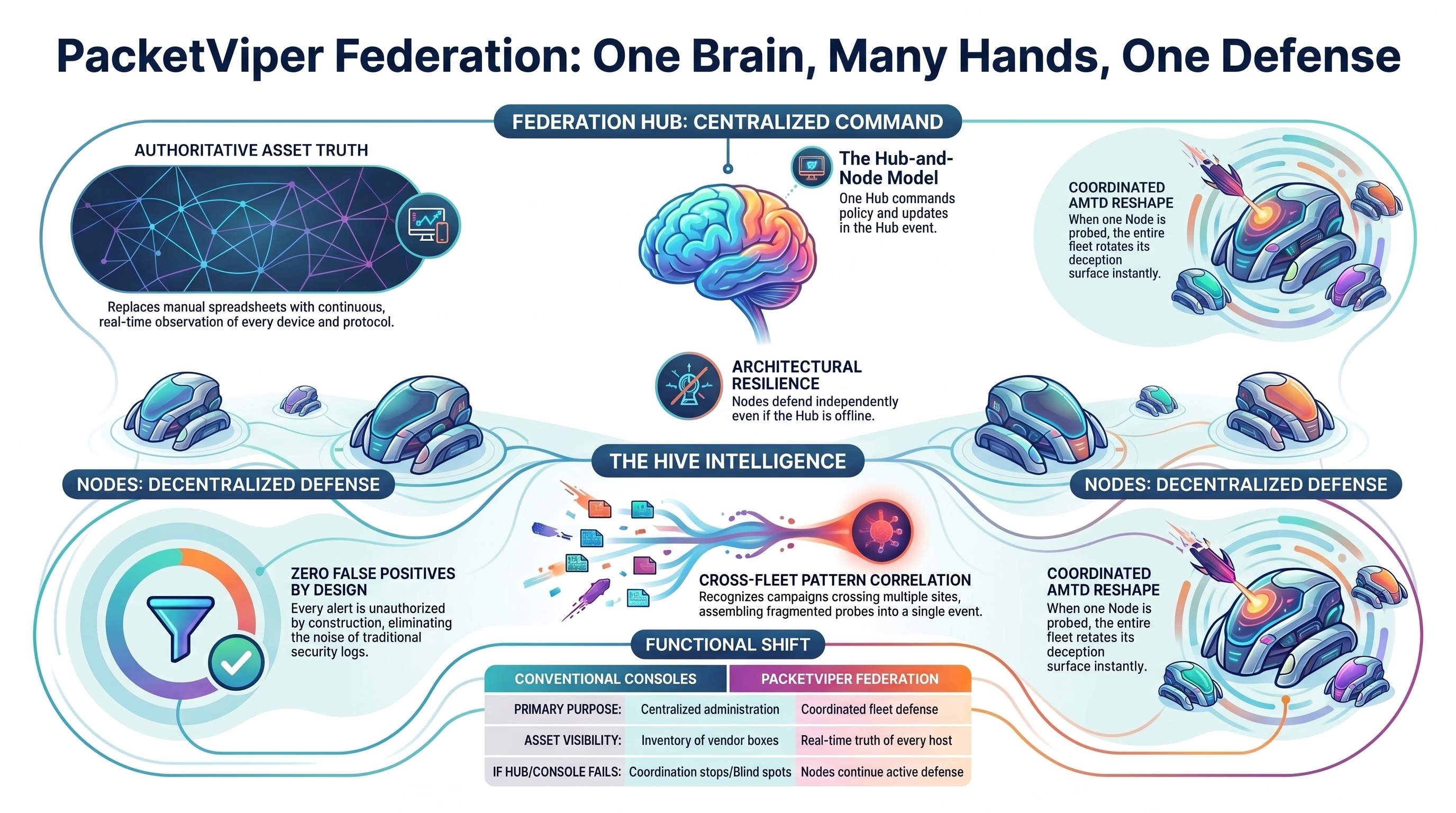
Most managers make you choose between control and scale. We didn’t.
Target the group. Override the node.
Apply policy to a group and every member gets it automatically. Need a surgical exception? Target any single node directly — no exceptions list, no workarounds, regardless of group membership.
Connect it. Walk away. Or don’t.
Active Sync hands full control to the Federation Manager — zero local touch required. Poll mode lets nodes pull their own relevant policies while keeping local management available. Built for how real networks actually work.
What makes Federation different.
Remote Site Autonomy
Each node enforces independently even if connectivity to the CMU is lost. Threats detected at a remote site trigger local blocking immediately, then propagate the block to all nodes when connectivity returns.
Enterprise-Wide Threat Response
When one node detects and blocks a threat, that block propagates across the entire federation. An attacker blocked at Site A is blocked at all sites within seconds.
Operational Simplicity
One interface for everything. Policy management, monitoring, investigation, compliance reporting, and system administration across every deployment.
Federation Manager — live walkthrough including endpoint agent management
Multi-site management, fleet-wide policy coordination, and endpoint AMTD agents — all from one console.
AMTD on the endpoint — managed from the same console.
The Federation Manager now includes endpoint agent management. The same pane of glass that runs your network AMTD deployment manages Windows and Linux endpoint agents across your fleet.
Host-resident AMTD
Deploy rotating deceptive responders on every Windows and Linux workstation and server in your fleet. The same moving-target doctrine that protects the network edge now runs inside the endpoint. 35+ rotating decoys per host, coordinated across the fleet by the Federation Manager.
Process-level attribution
When something connects to a decoy port, the agent captures the process name, the process ID, the user account, and the executable path — not just the source IP. The Federation Manager correlates host-side attribution with the wire-side flow the appliance already sees. One event record, two independent confirmations.
Hive Auto-Immunity
When a hive member’s endpoint is compromised and starts probing other hive members, the Federation Manager classifies that as a hive violation — not ordinary reconnaissance. The compromised host can be automatically isolated from every other protected endpoint in the fleet while the rest of the environment keeps running.
5 seats included with every FM
Every Federation Manager ships with 5 perpetual endpoint agent seats. The agent always defends — licensing only gates drill-in visibility in the UI.
Need endpoint AMTD without an appliance? Start at amtd.packetviper.com — same agent, hosted manager, five minutes to first defense.
One audit trail. Network + endpoint.
Every agent action — enrollment, update, tamper event, deception hit — is logged in the same SHA-256 hash chain audit trail as your network AMTD events. Auditors get one place to ask every compliance question. NERC CIP, NIST 800-53, IEC 62443, CMMC — one trail covers both surfaces.
Common questions about PacketViper Federation
What happens if the Federation Manager goes offline?
Every node defends itself autonomously. AMTD rotation continues, decoys keep firing, sensors keep blocking, and the enforcement posture on each node is unchanged. The hub coordinates; it does not enable. Operators lose centralized visibility during the outage, but protection at every site continues without interruption.
How is PacketViper Federation different from Panorama or FortiManager?
Panorama and FortiManager centralize administration — they are bigger filing cabinets for identical configs. PacketViper Federation centralizes command — every node is already defending, the hub coordinates fleet-wide intelligence, cross-site campaign detection, and AMTD rotation across the whole fleet. The hive sees patterns a single-site operator would never piece together in time.
Can I manage endpoint agents and network appliances from the same console?
Yes. The Federation Manager includes a Federation > Agents section for enrolling, monitoring, updating, and managing Windows and Linux endpoint AMTD agents. Same dashboard, same audit trail, same compliance export. One operator credential works for both surfaces.
Does the Federation support sub-hierarchies for large deployments?
Yes. Any node can be promoted to a Sub-Federation Manager for its own region. Regional hubs aggregate intelligence and report to the parent hub. Utilities with regional control centers, federal agencies with departmental authorities, MSPs managing multiple customers — the hierarchy maps to the organizational structure.
Central command without central dependency.
The hub coordinates; the node enforces. One policy model is expressed centrally and enforced everywhere – and every node keeps enforcing locally even if the manager is offline. Federated Enforcement is how control scales across sites without becoming a single point of failure.
The control loop: Observe → Understand → Decide → Enforce → Prove. Detection answers what did we see. Control answers what should be allowed to happen.
Explore the platform
OT Protocol Command Control
Inspect and enforce industrial commands inline. Modbus, DNP3, Siemens S7, NTCIP, BACnet, and SECS/GEM, governed per device, agentless.
Learn moreCompliance & Federal Alignment
The audit trail is a byproduct of operation, mapped to IEC 62443, NIST, and NERC CIP. U.S. owned, GSA and CHESS available.
Learn moreAnalytics & Visibility
Curated dashboards put the right information in front of the right people, before an attempt becomes an incident.
Learn moreAsset Management & Discovery
Passive discovery inventories every asset without scanning. 20+ OT protocols recognized, with vendor and model identity for Modbus, Siemens S7, and EtherNet/IP.
Learn moreSee Federation in action.
We’ll show you multi-site management on a live system, not a diagram.
Explore further
Reference material, definitions, and worked examples.