PacketViper: Preemptive Network Security with AMTD, Network Deception, and Inline Enforcement for IT and OT
Preemptive Security Platform
No agents ·
No cloud dependency ·
Inline enforcement
Control what AI can reach. Deceive and move what attackers target.
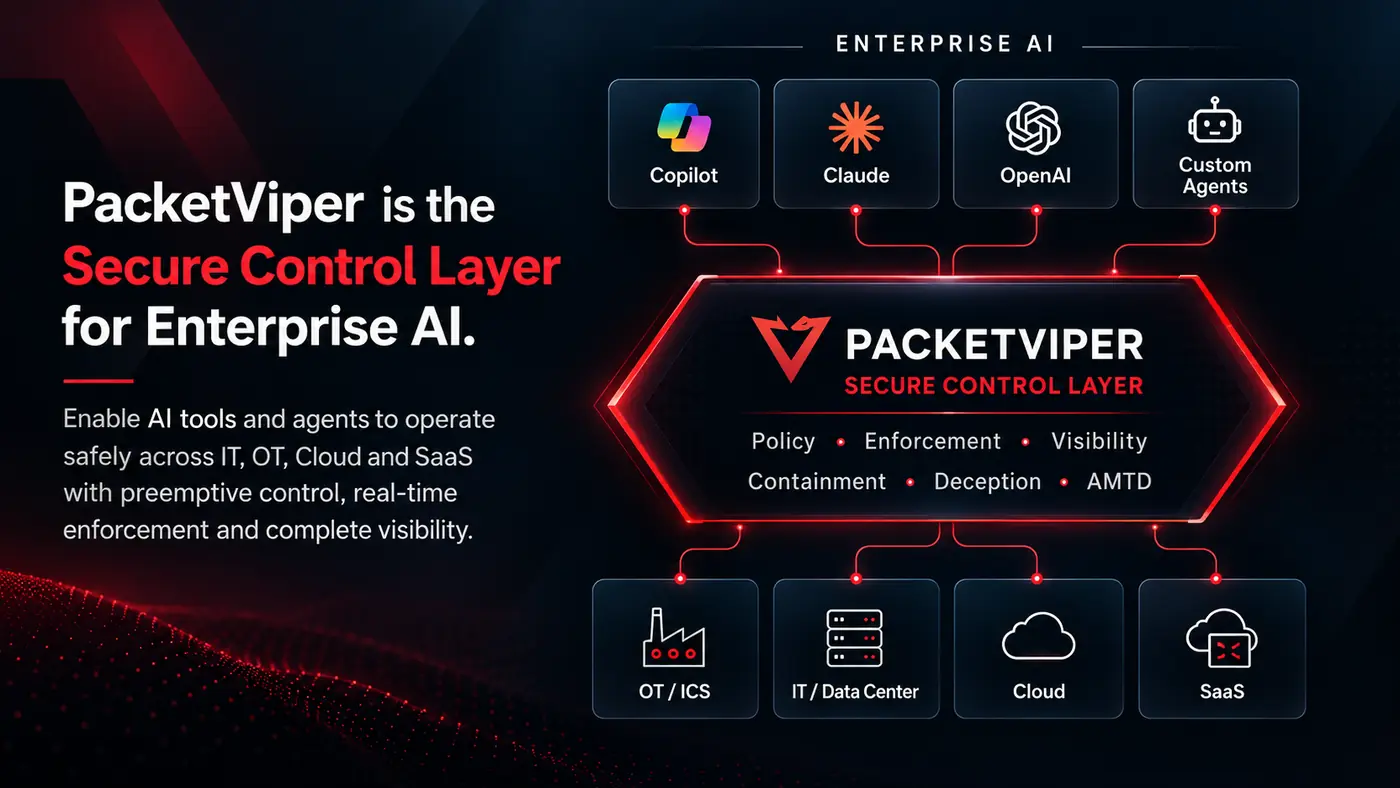
AI Secure Control Layer
Adopt AI tools and agents without losing control of your environment. PacketViper enforces inline what they can run, what data they can reach, and what actions they can take.
Network Deception & AMTD
Network deception plants decoys no legitimate user touches, and Automated Moving Target Defense keeps your real surface changing. Attackers who probe are blocked at first contact.
Featured in Gartner® Coolest Vendor Innovations in Cyber-Physical Systems Security, 2026
Gartner, “Coolest Vendor Innovations in Cyber-Physical Systems Security, 2026”, Wam Voster, Katell Thielemann, Ruggero Contu, Sumit Rajput, Avinash Dev Nagumanthri, 14 September 2026 (ID G00860575).
GARTNER is a trademark of Gartner, Inc. and/or its affiliates. Gartner does not endorse any company, vendor, product or service depicted in its publications, and does not advise technology users to select only those vendors with the highest ratings or other designation. Gartner publications consist of the opinions of Gartner’s business and technology insights organization and should not be construed as statements of fact. Gartner disclaims all warranties, expressed or implied, with respect to this publication, including any warranties of merchantability or fitness for a particular purpose.
Adopt AI without losing control of your environment.
PacketViper is the secure control layer that lets enterprises put AI tools and agents to work – while enforcing what they can reach, what data they can move, and how they behave when conditions change.
The same platform that protects complex IT and OT environments now serves as the control plane for safe AI adoption. One policy model. Consistent enforcement. Enforcement at the point of use – not another monitoring layer.
Your defenses are reactive. Attackers count on it.
Traditional security tools tell you what happened – after it happened. PacketViper changes the equation before the threat lands.
No Visibility Into Attempts
Your firewall logged a block. It didn’t tell you who, from where, or what reconnaissance came before it.
Detection After the Fact
SIEM alerts arrive minutes or hours late. By the time an analyst reviews the event, the attacker has already mapped your environment.
Static Surfaces Are Known
A network that doesn’t change is a network that can be fully mapped. Attackers catalog your infrastructure and wait.
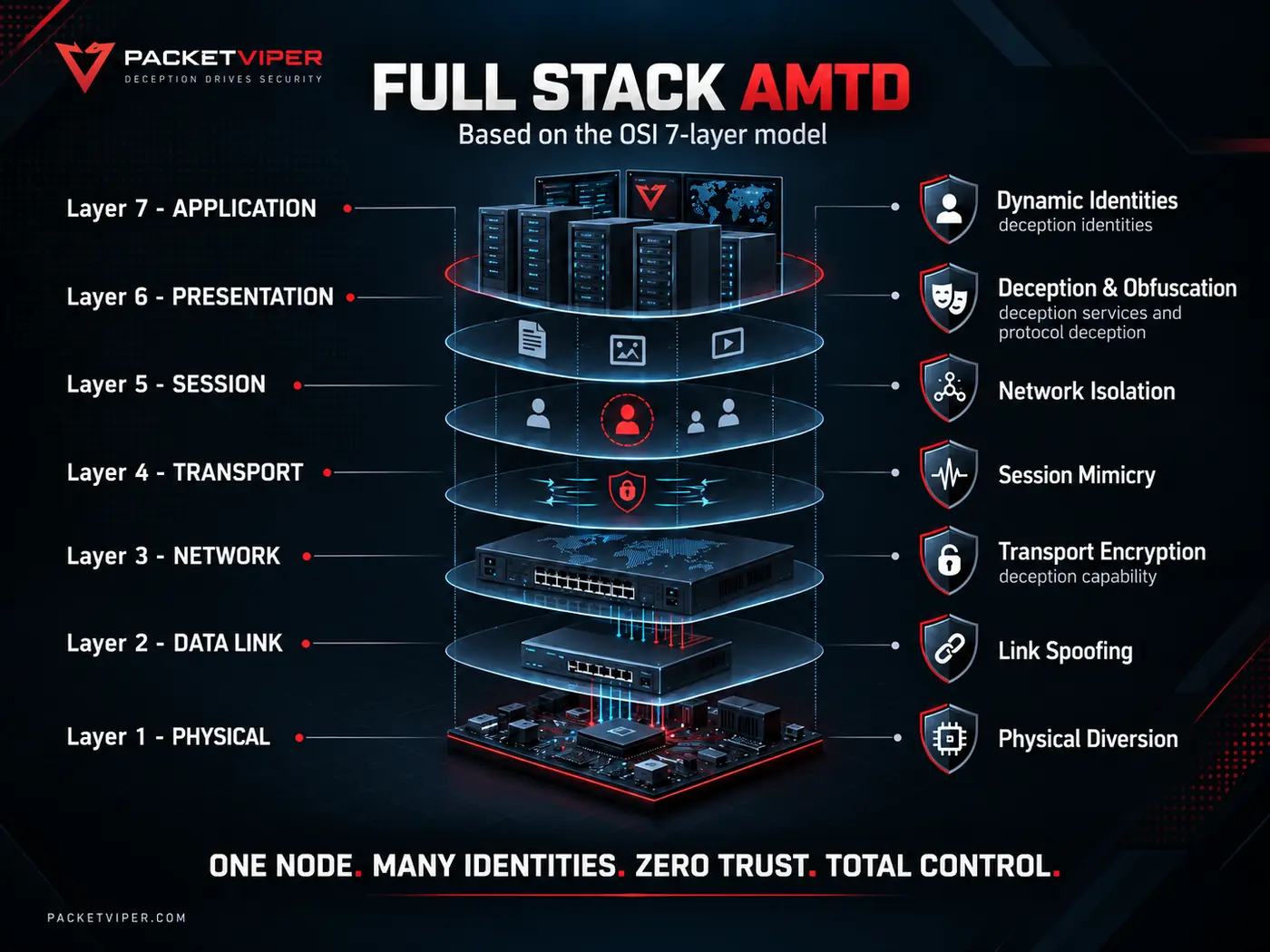
What Is Full-Stack AMTD?
PacketViper’s approach to preemptive defense. It degrades the reconnaissance tools attackers rely on, making it difficult for them to map networks, identify systems, or plan operations.
Traditional security tools focus on detection and response after an attacker has already gathered intelligence. Full-Stack AMTD works earlier by making tools like Nmap, Nessus, Shodan, and BloodHound return unreliable results. This prevents attacks from forming in the first place while still delivering detection, blocking, and contextual alerting when probes occur.
Full-Stack AMTD combines with PacketViper’s endpoint agents, OT integrations, traffic contextualization, logging, and analytics to create a complete preemptive security platform. It also covers the part of the surface where nothing is presented: Dark Space Monitor watches every unused port, so placement, coverage, and enforcement all rotate together.
Preemptive. Inline. Automatic.
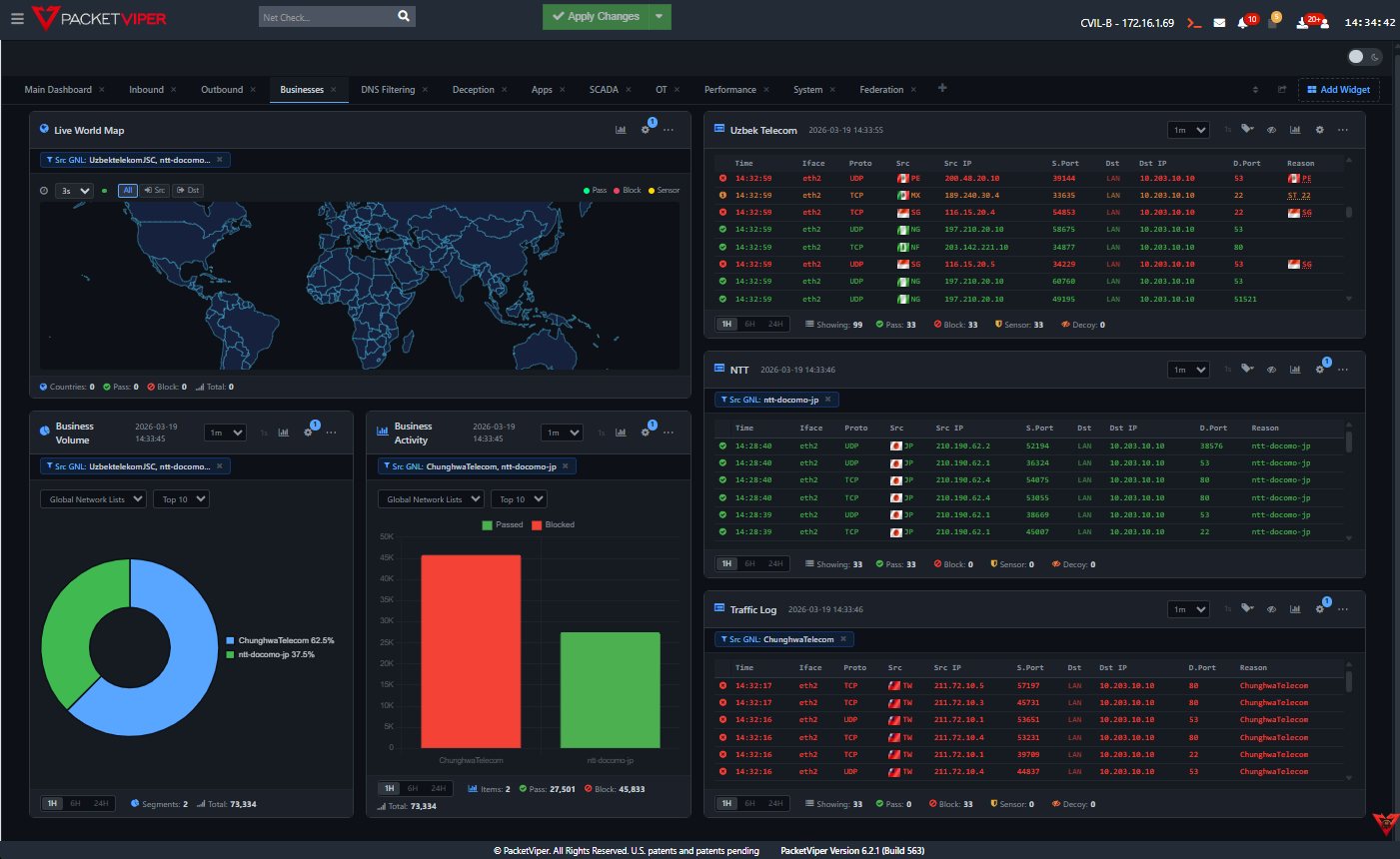
PacketViper sits in your traffic path – seeing everything, enforcing immediately, without agents or cloud dependencies.
Hunt Before the Hit
Distributed sensors watch for reconnaissance – port scans, banner grabs, lateral probes. Every attempt is captured and attributed before it becomes an attack.
Enforce Inline, Instantly
PacketViper enforces in the packet path. No endpoint agents, no cloud round-trips. Response is measured in microseconds.
Build Context on Every Actor
Every probe and connection attempt builds an attacker fingerprint. You get a persistent intelligence picture of who is targeting your infrastructure.
One platform. Every angle covered.
From deception layers to OT enforcement, PacketViper’s modules work together or independently.
AMTD – Moving Target Defense
Continuously rotates your network surface so attackers never map the same target twice. Static defenses get mapped. A moving one does not.
Deception
Convincing decoys across your environment. When something interacts, you get a high-confidence alert with full attribution.
OT Protocol Command Control
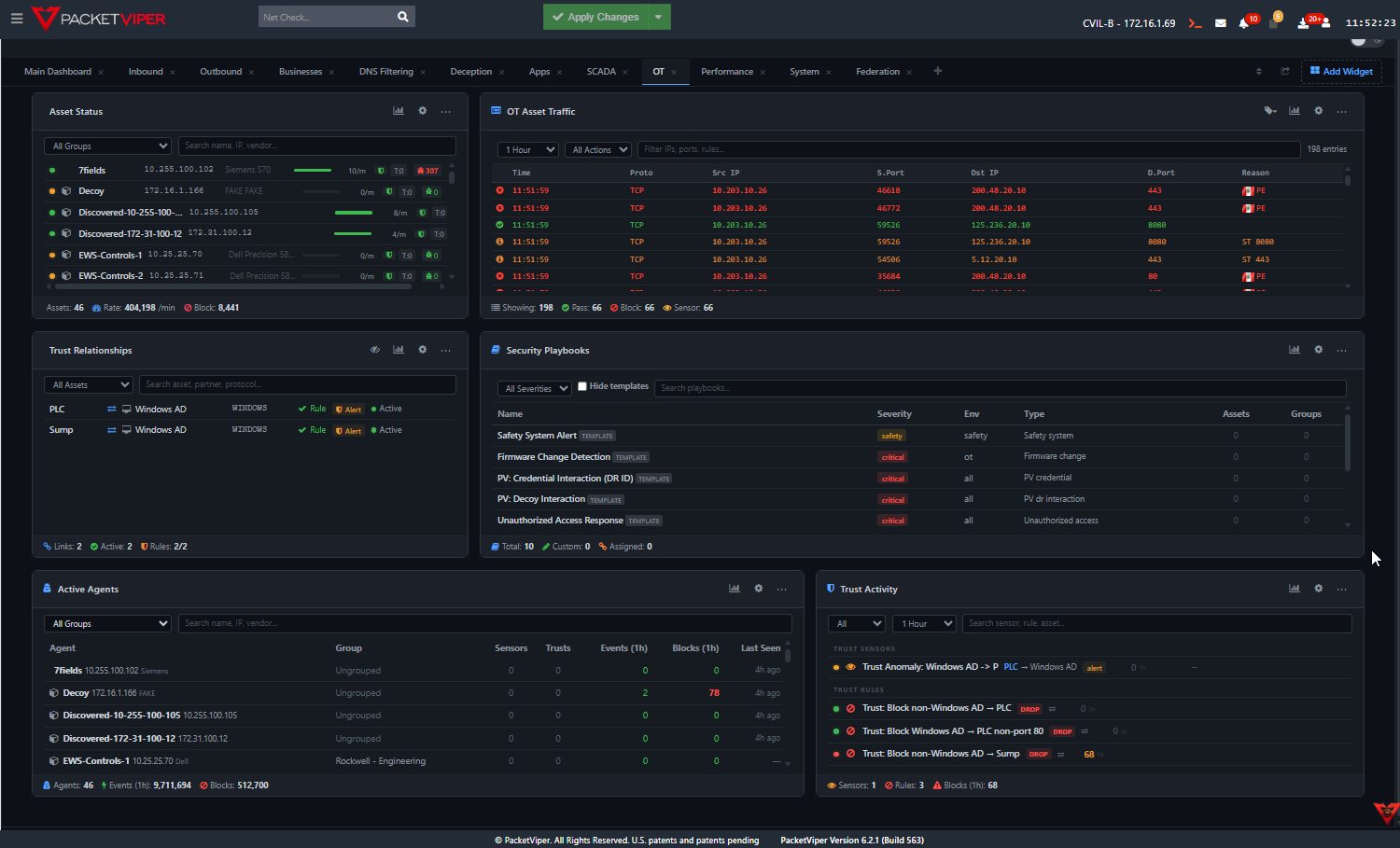
Inspect and enforce industrial commands inline. Modbus, DNP3, Siemens S7, NTCIP, BACnet, and SECS/GEM, governed per device, agentless.
OT / ICS / SCADA Security
Protocol-native protection for operational technology. No agents, no active scanning, fail-safe operation.
Asset Management & Discovery
Passive discovery inventories every asset without scanning. 20+ OT protocols recognized, with vendor and model identity for Modbus, Siemens S7, and EtherNet/IP.
Investigation & Threat Intelligence
Every blocked attempt becomes an investigation lead with attribution and context. Misconfiguration, unknown device, or genuine threat.
Analytics & Visibility
Curated dashboards put the right information in front of the right people, before an attempt becomes an incident.
Compliance & Federal Alignment
The audit trail is a byproduct of operation, mapped to IEC 62443, NIST, and NERC CIP. U.S. owned, GSA and CHESS available.
Federation – Central Management
Author policy once and enforce it identically across every site. One console for a national footprint.
Built For
The right tool for every stakeholder.
PacketViper speaks fluent security, OT, and boardroom – because the stakes are different for everyone at the table.
Stop chasing ghosts. Start hunting threats.
PacketViper gives your SOC real signal – not noise. High-confidence alerts, attacker fingerprints, and inline enforcement mean fewer escalations and more closed cases.
- Attacker attribution from first probe
- SIEM/SOAR integration ready
- No alert fatigue – high fidelity only
Security that doesn’t touch your operations.
RSUs sit passively in field cabinets. No agents on PLCs, no SCADA disruption, no cloud dependency. Instant visibility into your OT network without touching a single controller.
- Protocol-native: Modbus, DNP3, BACnet +7 more
- Fail-safe, zero-disruption design
- Works without central management
Measurable risk reduction. Real numbers.
In customer deployments, firewall traffic typically drops by up to 70% at the internet boundary within 90 days. Attacker dwell time cut from weeks to minutes. A platform that produces evidence for your board, not just your analysts.
- Quantifiable reduction in attack surface
- One platform, not five point solutions
- Rapid deployment – hours, not months
Get Started
See what your firewall never told you.
Book a live demo – we’ll show you in your environment, not ours.
PacketViper is a preemptive cybersecurity platform that enforces security inline before threats reach your network – using Automated Moving Target Defense, active deception, and OT-native protocol awareness to stop attacks at first contact without agents or SOAR dependencies.
Preemptive cybersecurity stops threats before they complete reconnaissance or reach target systems – acting at first network contact rather than detecting attacks after they are underway. PacketViper combines inline enforcement, AMTD, and active deception to create a security posture that does not depend on knowing what an attack looks like in advance.
No. PacketViper is entirely agentless – it operates at the network layer as a transparent Layer 2 bridge, requiring no software installation on any device it protects. This is critical for OT environments where PLCs, RTUs, and HMIs cannot support security software.
The Hive is PacketViper's enterprise-wide automated containment architecture. When any PacketViper unit detects a threat, it blocks it immediately, notifies the central Command Management Unit (CMU), and the CMU propagates that block to every unit across the enterprise – in milliseconds, without human intervention.
A firewall enforces rules written in advance – it blocks what it has been told to block. PacketViper enforces based on live context: source reputation, geographic origin, behavioral patterns, and OT protocol context. It also actively shifts the network's apparent attack surface through AMTD, making reconnaissance futile – something firewalls cannot do.
Network deception places realistic decoy services on your network – SSH, RDP, SCADA devices, PLCs, Active Directory portals – that no legitimate user or system has a reason to touch. Because nothing real depends on them, any connection to a decoy is a high-confidence sign of reconnaissance or attack, and PacketViper acts on it immediately.
A honeypot is a decoy that sits in one place and waits to be found. AMTD continuously changes the network surface – IP addresses, service configurations, and access points – so attackers have no stable surface to map. PacketViper builds its deceptive responders directly into the inline appliance and uses them together with AMTD in one integrated architecture.
When an attacker engages a deceptive responder, the local PacketViper unit immediately blacklists the source, blocks it, and notifies the central Command Management Unit (CMU), which propagates the block to every unit across the enterprise – in milliseconds, without human intervention, a SOAR playbook, or firewall integration.