RMF/ATO Acceleration Through Low-Burden Security Overlay
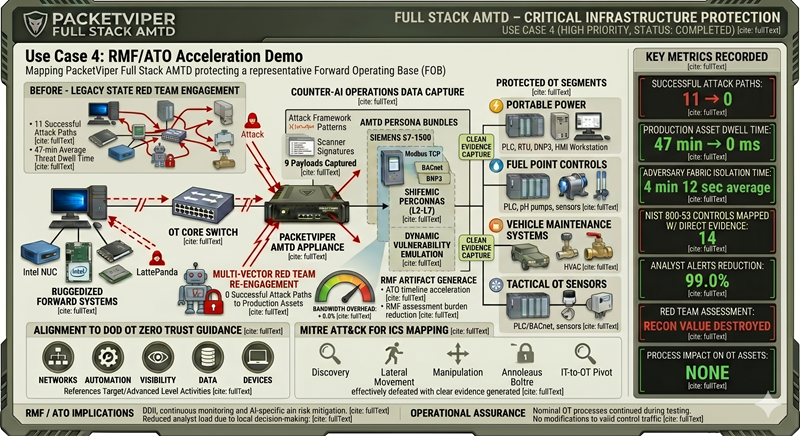
Before/after red team comparison. Same environment, same adversary, same attack scenarios. The only variable was PacketViper.
Click image to enlarge
Overview
Objective
The objective was to demonstrate that PacketViper deployment measurably reduces the effort, uncertainty, and timeline required to achieve and maintain ATO in a legacy-heavy OT environment. The focus was on producing real red team evidence and clean control mapping rather than compliance claims — empirical, before-and-after data that SCAs and Authorizing Officials can evaluate directly against their assessment criteria.
Summary of Results
The same structured red team engagement was executed twice against the same OT environment — first without PacketViper (baseline), then with PacketViper Full Stack AMTD deployed inline. The only variable between engagements was the presence of PacketViper.
Before: 11 successful attack paths with a 47-minute average dwell time on production assets. The red team documented complete capability to manipulate setpoints, breaker positions, and pump controls across all four OT segments without detection or interference.
After: Zero successful attack paths to production assets. Unauthorized protocol manipulation was blocked inline in under 2 milliseconds. Full containment was finalized within an average of 4 minutes and 12 seconds of initial adversary contact with a deceptive persona.
Built with operational Army experience to help accelerate RMF/ATO processes in OT and hybrid environments.
Test Approach
Baseline State (Before PacketViper)
The Use Case 1 lab topology was used with minimal existing security infrastructure representing a typical legacy OT environment: basic perimeter firewall rules, no inline inspection, and limited logging capability. This baseline represents the security posture common to OT environments that were deployed before the current generation of OT-aware security tools and have not been upgraded.
A structured red team engagement was executed and fully documented. A successful attack path was defined as any unique sequence resulting in unauthorized operational interaction with OT assets or control functions — including successful read of real PLC state, successful write to any register or coil, or successful lateral movement from the IT environment to the OT network without detection.
Results of the baseline engagement: the red team achieved 11 successful attack paths. Average dwell time on production assets was 47 minutes. The red team documented complete capability to manipulate setpoints, breaker positions, and pump controls across all four segments. No detection or interference occurred during the baseline engagement.
Protected State (After PacketViper Deployment)
PacketViper was deployed inline using the identical configuration from Use Case 1. No changes were made to the OT infrastructure, the perimeter firewall, the logging infrastructure, or the attack methodology. The identical red team engagement was re-executed by the same team with the same tooling against the same environment.
Results: zero successful attack paths to production assets within the test scope. Malicious protocol manipulation was blocked entirely at the inline boundary layer in under 2 ms. Threat actors were completely isolated across the network fabric within an average of 4 minutes and 12 seconds of their initial interaction with a Dynamic Vulnerability Emulation persona.
Side-by-side analysis confirmed that the PacketViper overlay functions as an immediate compensating control for legacy, un-agentable OT assets. The artifact generation was automatic — evidence for each enforcement action, deception interaction, and payload capture was produced as a direct output of protection operations, structured for direct RMF package ingestion without additional manual documentation steps.
Framework and Control Mapping
Compensating Control for Legacy OT
PacketViper functions as a non-disruptive, agentless overlay satisfying strict DoD Zero Trust mandates for legacy devices without requiring firmware modifications or hardware replacement cycles. This is particularly relevant for equipment that cannot be patched, updated, or modified without regulatory recertification — a constraint that is common in garrison and installation OT environments, and that creates a persistent gap in traditional security overlay strategies.
The before/after comparison in this engagement provides direct evidence that the compensating control is effective: the identical red team engagement against the identical OT environment produced 11 successful attack paths without PacketViper and zero successful attack paths with it. No modification to the OT infrastructure was required between engagements.
Continuous Authorization (cATO) Readiness
Deception telemetry and automated tool attribution shift the installation posture from static, point-in-time checklist compliance to automated, continuous control validation. The evidence stream is generated as a natural output of normal operations — not as a separate documentation step. Every deception interaction, enforcement action, and payload capture produces structured, timestamped, attributed data that maps directly to specific NIST 800-53 control families.
The 99% reduction in events requiring analyst review — from raw event volume to 3 actionable alerts per engagement — directly supports the continuous authorization posture. Analysts are presented with events that require human judgment, not a raw stream that must be filtered before it can be evaluated. The automation does not make the human decision for them; it presents the right information at the right time.
Artifact Automation and ATO Package Reduction
Direct mapping to 14 NIST 800-53 control families provides SCAs and Authorizing Officials with downloadable log evidence that is produced automatically during protection operations. Manual documentation timelines are reduced because the system generates the evidence package as a byproduct of doing its job. This benefit compounds across both the initial ATO timeline and the ongoing assessment cycles required for continuous authorization.
The deployment attack surface is minimal: a single inline appliance with zero agents on OT assets. RMF assessment scope stays proportionate to what was actually deployed. There are no agent installations to account for, no software on OT devices to inventory, and no changes to existing OT device configurations that would require re-assessment of the underlying systems.
MITRE ATT&CK for ICS
The following tactics were executed successfully against the baseline environment and defeated completely in the protected environment:
- Discovery (TA0102) — Successful in baseline; Full Stack AMTD personas defeated reconnaissance across L2–L7 in the protected state
- Lateral Movement (TA0100) — Successful in baseline (all 11 attack paths began with lateral movement from IT); contained at the boundary in the protected state
- Manipulation of Control (TA0104) — Successful in baseline (setpoints and breaker positions manipulated); blocked inline in the protected state with zero successful write commands
The side-by-side comparison against the baseline directly demonstrates control effectiveness for each of these tactics, providing clear, auditable evidence for each control family in the NIST 800-53 mapping.
Operational Safety Notes
Both the baseline and protected engagements were conducted with full safety protocols in place. All OT processes continued without deviation throughout the protected engagement. No setpoints, pump controls, valve positions, chemical dosing rates, or physical outputs were affected at any point during the PacketViper-protected engagement. Inline latency on OT protocols remained below 2 ms during both baseline collection and attack conditions. The appliance is configured fail-open throughout — on power loss or appliance fault, production traffic passes without modification.
No agents were installed on any OT assets during either engagement. The baseline engagement confirmed that the OT assets were fully functional and accessible to authorized operators throughout. The protected engagement confirmed that this functionality was preserved without modification while unauthorized access was blocked entirely.
Documentation Delivered
The following artifacts were produced as part of the engagement:
- Before/after network diagrams showing identical topology with and without PacketViper
- Before/after red team engagement reports with per-attack-path documentation
- PacketViper configuration export (Persona Bundles, AMTD parameters, sensor baselines, action handler policy)
- NIST 800-53 / DoD OT Zero Trust control mapping table with evidence references
- One-page summary: “Low-Burden Security Overlay — Measurable Impact on ATO Evidence”
- Video of before and after red team engagements showing the contrast in outcome
Run this use case in your environment
Contact us to discuss configuration and scope for your facility.
Request a Proof of Concept Book a Demo