The Secure Control Layer
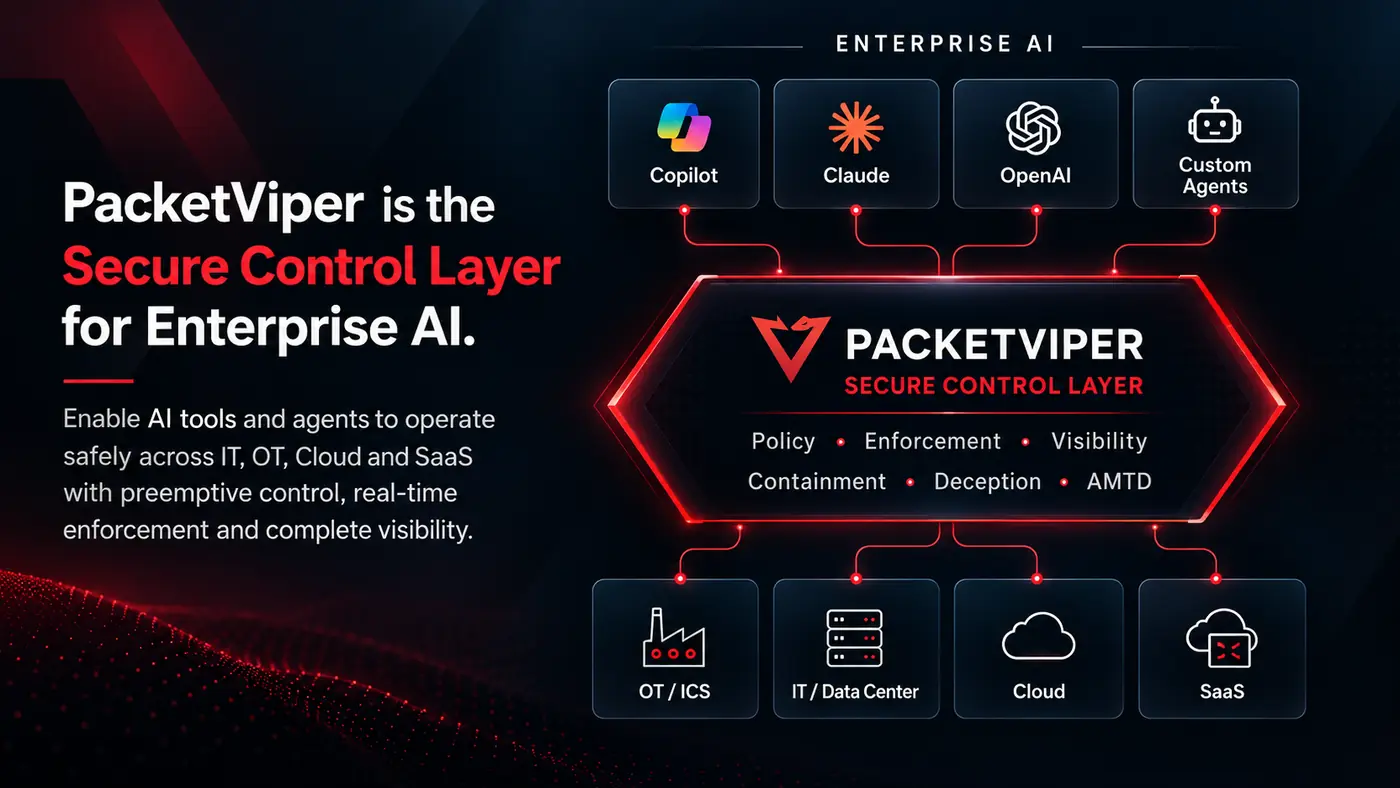
PacketViper is the secure control layer for the enterprise – the inline architecture where business policy becomes real-time behavior across IT, OT, cloud, remote sites, and AI.
Visibility tells you what happened. Control decides what is allowed to happen.
What is a Secure Control Layer?
A Secure Control Layer is an inline, distributed enforcement architecture that converts business policy, asset context, environmental knowledge, and threat intelligence into real-time control decisions.
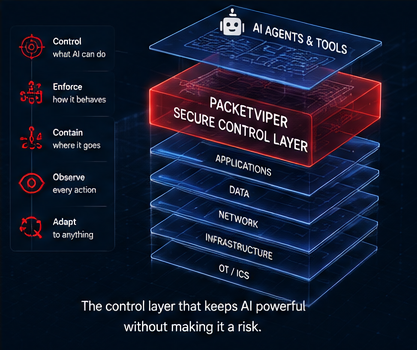
It is the operational bridge between what the business intends and what the network, applications, users, devices, and AI systems are actually allowed to do. In short: the Secure Control Layer is where policy becomes behavior. The word layer is intentional – like identity, networking, and data governance, it is a persistent architectural function, not a single appliance or dashboard.
One loop: Observe → Understand → Decide → Enforce → Prove
Every PacketViper capability serves one of these five functions. Together they close the loop between governance and execution.
Observe
Visibility into traffic, assets, zones, flows, and attempts – inline, where action occurs.
Understand
Context: asset role, zone, protocol, behavior, business relevance – not just IP and port.
Decide
Evaluate the action against business policy and acceptable behavior.
Enforce
Act inline – allow, block, contain, redirect, deceive, rate-limit, log, escalate, or isolate.
Prove
Preserve evidence as a byproduct of enforcement – for investigation, audit, and compliance.
Five forces are converging on the same requirement: governed control
AI gets the headlines, but it is not the only reason the architecture matters. These forces are different – they create the same need.
AI autonomy
Tools and agents pursue goals, chain actions, and adapt without step-by-step human instruction. Boundaries must govern what they can run, reach, and do.
IT/OT convergence
Enterprise systems now connect to operations that affect plants and physical processes. Policy must enforce at critical boundaries without modifying fragile endpoints.
Distributed infrastructure
Remote sites, substations, cloud workloads, and edge assets create many local enforcement points. Management must be federated; decisions must stay local and resilient.
Encrypted & machine traffic
More traffic looks normal, encrypted, or machine-generated. Context and policy matter more than signatures alone.
Compliance & audit pressure
Boards and regulators expect evidence, not just intent. Enforcement needs to produce continuous proof as a byproduct.
A control fabric, not another tool stack.
Most enterprises do not lack tools. They lack control.
A firewall enforces one boundary. An EDR protects a managed endpoint. A SIEM collects alerts. Each is useful, but the enterprise still assembles the control outcome by hand. A control fabric uses shared context, policy, and enforcement to make consistent decisions across domains – turning known policy outcomes into enforceable actions instead of future tickets.
The features are the proof points. The architecture is the message.
Every capability is a proof point of the control layer
Not separate products stitched together – the components required to make control operational.
AMTD
Removes stable truth from the network layer so reconnaissance and targeting become unreliable.
Deception
Deceptive responders are control points, not traps – contact is a high-confidence enforcement trigger.
Inline Policy Enforcement
Policy evaluated in the traffic path and enforced before the action becomes a business risk.
Federation
Central command without central dependency. The hub coordinates; the node enforces.
Asset Intelligence & Living Topology
Static inventory answers what exists. Asset Intelligence answers what should be allowed.
Threat Reach
Observed reach, not attribution – how far an indicator actually propagated across the environment.
What the Secure Control Layer is NOT
A credible architecture is clear about its edges.
- Not a rebranded firewall – which enforces static rules at one boundary
- Not a SIEM – which correlates events after they happen
- Not only Zero Trust Network Access – which governs user and application access
- Not only an AI gateway – which sees model calls only
- Not a replacement for endpoint detection – it complements EDR, identity, cloud, SaaS, and data controls
Does your architecture have a control layer?
If you answer no to several of these, you have visibility – not control.
- Can it enforce a decision inline, in the traffic path – not just observe?
- Does it use asset, zone, protocol, and business context – not just IP and port?
- Can it express business policy, not only static rules?
- Does it keep enforcing across sites even when central management is offline?
- Can it govern AI tools and agents – what they can run, reach, and do?
- Does it produce evidence as a byproduct of enforcement?
- Can it shape the environment so reconnaissance becomes unreliable?
- Does one policy model span IT, OT, cloud, and remote sites?
- Can it contain unauthorized behavior at first contact, before the action completes?
- Can it turn a sighting into reach – how far an indicator actually propagated?
Detection can be probabilistic. Enforcement must be deterministic.
PacketViper provides network-layer containment for behavior that must cross a monitored enforcement boundary – validated in PacketViper Research, “Autonomous AI Agent Containment Using AMTD” (March 2026), in which an autonomous agent was stopped at the first sensor across four configurations, reached no internal hosts, validated no real credentials, and exfiltrated no data. It does not claim to solve every AI or security scenario, and it complements – rather than replaces – endpoint, identity, cloud, SaaS, DLP, and prompt-governance controls.
Secure Control Layer – common questions
A secure control layer is an inline, distributed enforcement architecture that turns business policy, asset context, and threat intelligence into real-time control decisions. It is the bridge between what the business intends and what users, devices, applications, and AI systems are actually allowed to do – the place where policy becomes behavior.
A firewall enforces static rules at one boundary. A SIEM correlates events after they happen. A secure control layer observes, understands context, decides against business policy, and enforces inline across many boundaries – then preserves the evidence. It uses context, not signatures alone, and it acts before the action completes.
It can allow, block, contain, redirect, deceive, rate-limit, log, escalate, or isolate – based on identity, asset, zone, destination, behavior, and business context. Enforcement happens in the traffic path, at the point of use.
No. It is the inline enforcement layer. It complements EDR, identity, SIEM, cloud, SaaS, and data controls – and reduces their workload by enforcing known policy outcomes before they become alerts and tickets.
AI becomes another workload governed by the same model: what tools can run, what data they can reach, what actions they can take, where they can connect, and what happens when behavior deviates from approved context – enforced at the network layer, at the point of use.
See the control layer enforce in your environment.
Book a live demo. We’ll show you in your environment, not ours.
Explore further
Cyber-physical systems and protection at the infrastructure edge.