Tactical Edge / Contested Logistics Network Defense
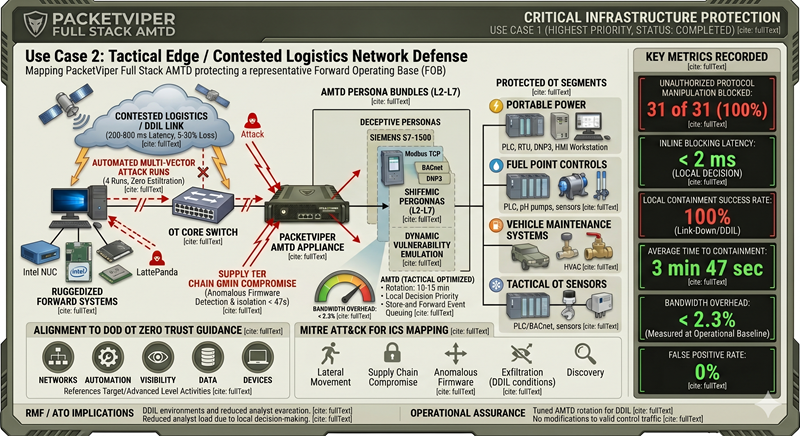
Inline enforcement during disconnected operations. Tested in a DDIL environment with 200–800 ms latency and 5–30 minute link-down periods.
Click image to enlarge
Overview
Objective
The objective was to demonstrate PacketViper delivering Zero Trust enforcement outcomes in bandwidth-constrained, intermittently connected environments where agent-based or cloud-dependent tools fail. The engagement focused on contested logistics and forward-deployed systems — scenarios where continuous internet or headquarters connectivity cannot be assumed and local decision-making capability is operationally mandatory.
Summary of Results
Four independent automated runs were executed in a Denied, Degraded, Intermittent, or Limited (DDIL) communications environment. All four runs were fully contained. Local decision-making maintained 100% containment during disconnected intervals — enforcement did not degrade when the uplink to central management was severed. Zero exfiltration occurred across all four runs. Control-plane sync overhead measured below 1.5 Kbps throughout operational baselines.
Built with operational Army experience to support contested logistics and forward-deployed system resilience requirements.
Test Environment
Lab Configuration
The test environment built on the Use Case 1 OT asset set — vehicle maintenance controls, portable power generation, and fuel point systems — representing the operational technology present at a forward logistics element. Two to three small form-factor edge nodes representing ruggedized forward systems were added to simulate the compute profile typical of tactical deployments on vehicles and at forward operating positions.
A network emulation layer was introduced between the tactical node and the simulated wide-area link. The emulation layer produced conditions spanning the full DDIL spectrum: 200–800 ms one-way latency, 5–30% random packet loss, and complete link-down periods ranging from 5 to 30 minutes. Testing covered both the always-on low-bandwidth scenario typical of satellite links and true connect/disconnect patterns representative of mesh radio networks and on-the-move communications.
OT Asset Segments
- Vehicle Maintenance — diagnostic and telematics interfaces on simulated tactical vehicles, Modbus-accessible sensor data
- Portable Power — generator control and load management PLC (Modbus TCP), fuel consumption metering
- Fuel Point Controls — pump control and tank level monitoring PLC (Modbus TCP), simulated dispensing valves
No agents were deployed on any PLC, RTU, or tactical edge device at any point during the engagement. The configuration was identical to a deployed system where software installation on OT assets is operationally prohibited.
PacketViper Configuration
Deployment Mode
PacketViper was deployed inline at the tactical node boundary in bridge mode. The same Modbus, DNP3, and BACnet persona profiles used in Use Case 1 were active. Profiles function correctly when the uplink is down — deceptive responses, enforcement, and sensor triggering all operate on local state without requiring central connectivity.
DDIL-Optimized Parameters
Several configuration parameters were adjusted from the garrison baseline to optimize for DDIL operation without compromising containment effectiveness:
- AMTD rotation interval — extended to 10–15 minutes from the 2–5 minute garrison setting, reducing control-plane synchronization overhead while maintaining meaningful deceptive variance
- MAC/IP mutation throttling — mutation events were throttled during detected low-bandwidth periods to minimize overhead on constrained links
- Local decision-making priority — enforcement executes locally without waiting for central policy sync; the enforcement engine holds complete policy state on-device
- Event queuing — alerts and logs are buffered in durable local storage during link-down intervals and synced to central management on reconnect with no event loss
- Sync policy threshold — configuration deltas and event sync operations are deferred until link quality exceeds a configurable threshold, preventing sync traffic from competing with operational data
Disconnected Operations Behavior
During link-down periods, PacketViper operated in a fully autonomous enforcement posture. Sensor triggers, blacklisting, persona presentation, and Dynamic Vulnerability Emulation all continued without any central connectivity. On link restoration, the appliance automatically synchronized its event queue and received any policy updates that had accumulated during the disconnection interval. This behavior was verified across eleven link-down cycles during the engagement.
Observed Results
Reconnaissance Under Intermittent Connectivity
Attackers mapping assets during brief connectivity windows received coherent false responses across multiple disconnect/reconnect cycles. Because AMTD rotation continued during link-down periods, the topology data gathered during one connectivity window was inconsistent with data gathered during subsequent windows. The mapping data went stale between windows rather than accumulating into a reliable picture. Average time from scan initiation to first deceptive response was 2.1 seconds — slightly higher than the garrison baseline due to the emulated latency environment.
Automated Multi-Vector Runs
Four independent runs were executed. All four were fully contained. Local decision-making maintained 100% containment during disconnected periods across every run — there was no degradation in enforcement effectiveness during link-down intervals. Average time to containment was 3 minutes and 47 seconds. No exfiltration occurred despite the high-latency, high-loss network conditions that allowed narrow windows where outbound traffic might otherwise have escaped.
Supply Chain Compromise Scenario
A supply chain compromise scenario was executed in which an edge node was introduced exhibiting anomalous behavior consistent with compromised firmware — including unexpected outbound connection attempts and protocol-layer probing of adjacent devices. The node was detected at the boundary based on behavioral deviation from its established baseline. Isolation was completed within 47 seconds of the first anomalous event. This scenario was executed while the central management link was in a simulated down state, confirming that supply chain anomaly detection does not depend on central connectivity.
Exfiltration During Narrow Connectivity Windows
Exfiltration attempts timed to exploit brief connectivity windows — a technique that takes advantage of the window of exposure when intermittent links come online — achieved 0% success. Blacklisting executed locally in advance of the exfiltration attempt in every trial. The enforcement layer does not require connectivity to enforce a blacklist decision that was made locally.
Alert Volume and Bandwidth
87 raw events were generated across all four runs. Four required analyst action — a 95.4% reduction from raw event count to actionable alerts. Bandwidth overhead for control-plane synchronization measured at 2.3% of available throughput, with peak sync traffic remaining below 1.5 Kbps at operational baseline. This overhead was verified at the 200 ms, 400 ms, and 800 ms latency settings. No sync storm was observed following any link restoration event.
Framework and Control Mapping
DoD OT Zero Trust Alignment
This deployment maps to the same four pillars of the DoD Zero Trust for Operational Technology Activities and Outcomes framework as Use Case 1, with particular emphasis on the disconnected operations requirement. The DoD OT Zero Trust framework explicitly addresses the need for Zero Trust enforcement to remain effective in DDIL environments — a requirement that agent-based and cloud-dependent architectures cannot satisfy by design.
- Networks and Environments — Inline enforcement at the tactical boundary with full local policy authority during disconnected intervals
- Automation and Orchestration — Autonomous enforcement during DDIL, event queuing for sync on reconnect, zero event loss across eleven link-down cycles
- Visibility and Analytics — 87 raw events reduced to 4 actionable alerts; no data loss during link-down periods; complete event history available on reconnect
- Devices — Agentless; supply chain anomaly detection at the boundary without requiring any modification to edge nodes or OT assets
MITRE ATT&CK for ICS
The following tactics were tested and defeated across all four runs:
- Discovery (TA0102) — Recon during intermittent connectivity windows produced inconsistent, unusable data across all runs
- Lateral Movement (TA0100) — Contained at the tactical boundary in all four runs including during link-down intervals
- Inhibit Response Function (TA0103) — Write command blocking maintained without central connectivity
- Manipulation of Control (TA0104) — No successful unauthorized control commands reached production assets
- Supply Chain Compromise (T1195) — Anomalous edge node isolated within 47 seconds during a link-down interval
- Exfiltration (TA0010) — Zero exfiltration across all attempts including those timed to exploit connectivity windows
RMF and ATO Implications for Expeditionary Systems
Local enforcement and event queuing support ATO evidence requirements for expeditionary systems operating in DDIL environments. The event queue ensures that no enforcement action or security event is lost during disconnected operations — the audit trail is complete regardless of connectivity at the time of the event. This is a direct requirement for continuous authorization of systems that operate without guaranteed connectivity.
14 NIST 800-53 controls are evidenced across this engagement, with specific evidence for controls requiring continuous monitoring in environments where monitoring infrastructure is intermittently unavailable.
Operational Safety Notes
All OT processes continued without deviation throughout the engagement, including during link-down and link-restoration transitions. Inline latency on OT protocols remained below 2 ms during both baseline collection and attack conditions across all emulated latency environments. The appliance is configured fail-open — on power loss or appliance fault, production traffic passes without modification, preserving mission-critical operations.
The AMTD rotation interval of 10–15 minutes was selected specifically to optimize for DDIL while ensuring zero network overhead on the local tactical loop. This cadence provides meaningful deceptive variance while eliminating the control-plane sync traffic that would otherwise accompany more frequent rotation. No rotation event generated broadcast storms, ARP noise, or routing table updates visible to legitimate OT devices. Fail-open inline bridging preserved continuity during appliance restart scenarios executed as part of the engagement.
Documentation Delivered
The following artifacts were produced as part of the engagement:
- Topology diagram showing contested link emulation layer and PacketViper placement
- Bandwidth and latency impact report with per-condition measurements
- Test results from four independent DDIL runs with per-run event logs
- NIST 800-53 / DoD OT Zero Trust control mapping spreadsheet
- Video of attack execution and containment across link-down and link-restoration transitions
Run this use case in your environment
Contact us to discuss configuration and scope for your facility.
Request a Proof of Concept Book a Demo